

What Is Elicit AI?
elicit ai coupon is a common search from buyers who want to lower the cost of an AI research assistant before they subscribe. Elicit AI is a research workflow platform built for finding papers, generating research reports, screening studies, extracting data, and chatting with papers instead of acting like a general purpose AI writer.
Its current product positioning is strongest for academic, scientific, and evidence based research workflows. Elicit AI offers unlimited paper search on all plans, workflow based subscriptions, Zotero import, clinical trial search on paid tiers, and higher tier features for systematic reviews, alerts, API access, and team collaboration.
Who It Is For
It fits researchers, students, analysts, academics, and evidence focused teams that need to search literature, review papers, and structure findings faster.
Best Use Case
It works best for literature reviews, research reports, systematic reviews, and evidence extraction workflows where source depth matters more than general content generation.
Standout Value
Its standout value is research workflow depth, because Elicit AI combines paper discovery, summaries, chat, extraction, and systematic review tools in one platform.
Setup Time and Support
Setup is fast because Elicit AI has a free Basic plan and self serve paid tiers for individuals, while larger groups can move into Scale or Enterprise plans.
Why Elicit AI Stands Out
It stands out because it is built around research tasks, not generic prompting, and its plan structure is aligned to workflows like reports and systematic reviews rather than only chat usage.
Key Features
Feature | What it does | Why it matters |
Unlimited paper search | Searches across more than 138 million papers on all plans. | Gives users a broad research starting point without metering basic discovery. |
Research Reports | Generates structured reports from research questions and sources. | Helps users move from question to evidence summary faster. |
Systematic Review workflow | Supports search, screening, extraction, and synthesis in one guided workflow. | Makes Elicit AI more useful for rigorous evidence review than standard paper search tools. |
Paper Chat | Lets users chat with papers using full text access when available. | Helps users interrogate sources without reading every paper line by line first. |
Data extraction | Extracts data from papers and research sources into structured outputs. | Reduces manual extraction work in review and synthesis workflows. |
Zotero import | Connects with Zotero so users can bring collections into Elicit AI. | Makes migration from existing research libraries easier. |
Alerts | Supports personalized research alerts on higher tiers. | Helps users track new literature without rerunning searches manually. |
API access | Includes API access on higher plans. | Gives advanced users and teams a path to custom research workflows. |
These features and limits are described across Elicit AI’s pricing and support documentation, including the workflow based subscription model, Zotero integration, and systematic review guides.
Elicit AI Top Integrations
Elicit AI’s strongest integrations focus on reference management, alerts, API workflows, and collaborative research rather than a broad app marketplace. Its current documentation highlights Zotero import, API access, alerts, and team collaboration as the most practical ways Elicit AI connects into real research workflows.
- Zotero: Import paper collections from Zotero directly into Elicit AI so you can analyse, screen, and extract from an existing research library faster.
- Elicit Alerts: Create personalized alerts that feed newly relevant papers into your library for ongoing literature monitoring.
- Elicit API: Connect Elicit AI to custom scripts, apps, or internal research workflows for semantic search and automated report generation.
- Shared team workflows: Use live editing and real time collaboration on the Scale plan so multiple researchers can work inside the same review or report.
- Clinical trial search: Use paid plans to search across more than 500 thousand clinical trials alongside paper discovery.
Pros and Cons of Elicit AI
Elicit AI is strong for structured research workflows, but it is less suited to buyers who want broad general productivity integrations, low cost high volume team access, or a simple flat usage model.
Its current pricing and support pages position it around research reports, systematic reviews, alerts, extraction, and workflow based subscriptions rather than generic AI chat.
Pros | Cons |
Unlimited Paper Search: All plans offer unlimited searching across a massive database of more than 138 million research papers. | Workflow-Centric Limits: Heavy users must monitor report and review allowances closely, as these are central to the pricing model. |
Integrated Research Tools: Built for serious research with reports, systematic reviews, paper chat, and data extraction in one workflow. | High-Value Feature Gating: Key tools like alerts, API access, and advanced systematic reviews are reserved for Pro, Scale, or Enterprise tiers. |
Systematic Review Rigor: Pro and higher tiers support systematic reviews, providing more academic depth than standard AI search tools. | Rapid Pricing Escalation: Scale and Enterprise costs rise quickly for teams, which may challenge budget-sensitive research groups. |
Advanced Team Collaboration: The Scale tier adds real-time collaboration, pooled workflow limits, and administrative controls for group projects. | Narrow Integration Ecosystem: Main connections are limited to Zotero, API, and internal tools rather than a broad third-party app marketplace. |
Enterprise Governance: Adds critical security like SSO/SAML, custom deployments, and a guarantee that AI is not trained on your data. | Beta API Status: API access is still in beta, meaning pricing, rate limits, and features are subject to change without much notice. |
The first 3 drawbacks are documented on Elicit AI’s pricing and API materials. The integration depth point is an inference from the current public product surface.
Elicit AI Pricing Plans
Verify pricing on the official website. The information may change. For the most accurate, up to date, and full feature breakdowns, please visit the official Elicit website. Elicit AI currently offers 5 public plan tiers: Basic, Plus, Pro, Scale, and Enterprise.
Plan | Price | What it includes |
Basic | Free | Includes limited access to Research Agent, 2 Automated Reports per month, unlimited search across more than 138 million papers, unlimited summaries, unlimited paper chat, source viewing, and Zotero import. |
Plus | $7 per user per month, billed annually at $84 | Includes everything in Basic, plus more daily Research Agent access, export to RIS, CSV, BIB, PDF, and DOCX, 4 Automated Reports per month, and unlimited search across more than 500 thousand clinical trials. |
Pro | $29 per user per month, billed annually at $348 | Includes extended Research Agent access, systematic reviews that can screen 5,000 papers, 144 Reports or Systematic Reviews per year, custom extractions, 10 personalized Alerts, explanations for AI generated answers, multiple output templates, and API access. |
Scale | $49 per user per month, billed annually at $588 | Includes everything in Pro, plus full Research Agent access, figure extraction, live editing, real time collaboration, 240 Reports or Systematic Reviews per year, an admin panel, seat management, and pooled workflow limits. |
Enterprise | Custom pricing | Includes full Research Agent access, unlimited alerts, no training on your data by default, greater screening and extraction scale, SSO and SAML, 2FA, domain verification, custom deployments, customer success support, and unlimited API access. |
Elicit AI also uses workflow based subscriptions, which means usage is tracked by Reports and Systematic Reviews rather than older paper extraction counts. Find Papers and Paper Chat remain unlimited across plans and do not count toward workflow usage.
The safest way to find a valid elicit ai coupon, elicit ai discount coupon, elicit ai discount, or elicit ai coupon code is to check the official pricing page first. I did not find a broad public coupon code system on Elicit AI’s official pricing or billing documentation.
Elicit AI Reviews
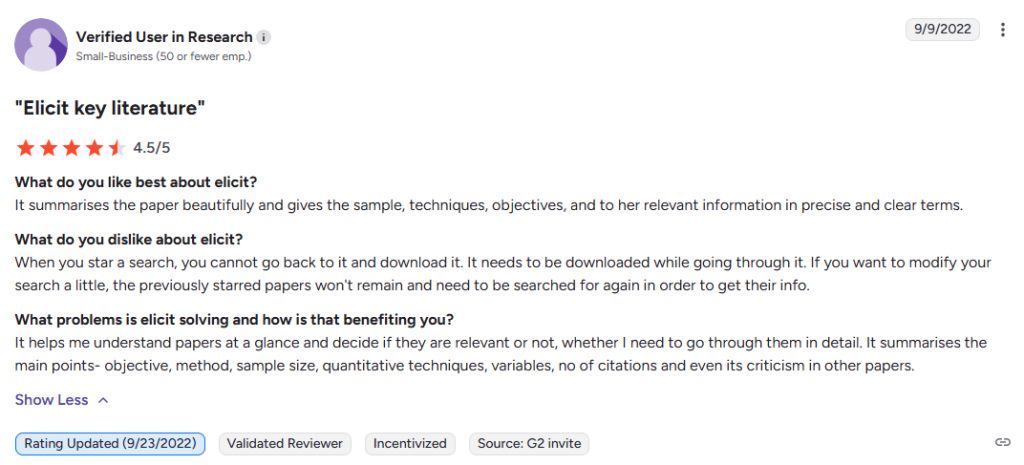
Public review coverage for Elicit AI is still limited, but the available signals are positive overall. G2 currently shows Elicit at 4.5 out of 5 from 1 review, while Capterra shows 5.0 out of 5 from 1 review. That points to promising user sentiment, but the sample size is too small for strong conclusions.

Alternatives of Elicit AI
- Consensus is best for researchers that want an AI academic search engine with cited answers from scientific papers. Choose it when fast question answering matters more than Elicit AI’s workflow based reports and systematic review structure.
- ResearchRabbit is best for researchers that want visual literature discovery and citation mapping. Choose it when paper networks matter more than Elicit AI’s extraction and review workflows.
- Scite is best for researchers that want citation context and Smart Citations. Choose it when claim checking matters more than Elicit AI’s report and screening workflows.
- Litmaps is best for researchers that want to map and monitor literature landscapes from seed papers. Choose it when tracking topic evolution matters more than Elicit AI’s structured workflow subscriptions.
- Zotero is best for academics and students that need proven reference management and citation control. Choose it when library ownership matters more than Elicit AI’s AI first workflows.
- Paperpile is best for researchers that want browser based reference management and Google Docs citation support. Choose it when writing integration matters more than Elicit AI’s reports, alerts, and systematic review tools.


