

What Is Arize AI?
Arize AI is an AI observability and evaluation platform for building, tracing, evaluating, and monitoring AI applications, so arize ai coupon intent should be checked against the official pricing page before assuming a public coupon code exists. Arize’s current product ecosystem includes Arize AX for enterprise AI observability and Arize Phoenix, its open source LLM tracing and evaluation platform.
Arize AI helps AI engineering, ML, and data science teams connect development and production workflows through traces, evaluations, prompt optimization, monitoring, dashboards, drift detection, annotations, and dataset analysis. Its pricing page lists Phoenix, AX Free, AX Pro, AX Enterprise, and startup pricing, but it does not show a public coupon code on the reviewed pricing page.
Who It Is For
Arize AI is for AI engineers, machine learning teams, data scientists, platform teams, and enterprises that need observability across LLM, agent, ML, and computer vision systems. The platform fits teams that need prompt evaluation, tracing, production monitoring, model drift detection, custom dashboards, and reliable AI application debugging.
Best Use Case
Arize AI is best used for monitoring and improving AI applications from development through production. Strong use cases include LLM tracing, agent evaluation, prompt optimization, online evaluations, human annotation, model monitoring, embedding drift detection, and root cause analysis for underperforming model slices.
Standout Value
Arize AI’s standout value is its ability to connect AI observability, evaluations, tracing, prompt workflows, and production monitoring in one platform. Arize states that its platform closes the loop between development and production by using real production data to improve development and align observability with trusted evaluations.
Setup Time and Support
Arize AI has multiple setup paths because buyers can start with Phoenix, AX Free, AX Pro, startup pricing, or AX Enterprise. The pricing page lists Phoenix as free and open source, AX Free as a $0 SaaS plan, AX Pro at $50 per month, AX Enterprise as custom priced, and startup pricing for teams building AI applications.
Why Arize AI Stands Out
Arize AI stands out because it covers both open source LLM observability through Phoenix and enterprise AI observability through Arize AX. Phoenix is open source, self hostable, built on OpenTelemetry, and designed for tracing, evaluation, experimentation, prompt workflows, dataset clustering, and LLM tool debugging.
Key Features
Arize AI’s key features focus on AI observability, LLM tracing, evaluations, prompt workflows, production monitoring, drift detection, and enterprise governance.
| Feature | What it does | Why it matters |
| LLM tracing | Captures spans, traces, sessions, framework activity, and OpenTelemetry based instrumentation. | Helps AI teams debug agents, RAG apps, prompts, tool calls, latency, and cost across development and production. |
| Arize Phoenix | Provides an open source LLM tracing and evaluation platform for instrumenting, experimenting, and optimizing AI applications. | Gives smaller teams and developers a self hostable path before moving into enterprise AI observability. |
| Arize AX | Provides enterprise observability for generative AI, ML, computer vision, agents, and AI applications. | Fits organizations that need production scale monitoring, dashboards, collaboration, security, and support. |
| Evaluations | Supports offline evaluations, online evaluations, LLM as judge workflows, code evals, human annotations, and labeling queues. | Helps teams measure answer quality, catch regressions, validate prompts, and improve model behavior with structured feedback. |
| Prompt workflows | Includes prompt optimization, replay in Playground, prompt serving, prompt management, and prompt experiments. | Helps AI teams test prompts, compare outputs, manage versions, and reduce production risk before rollout. |
| Monitoring and dashboards | Tracks production metrics, creates custom dashboards, evaluates production data, and supports alerts. | Helps teams detect quality drops, drift, latency issues, and abnormal production behavior. |
| ML and computer vision observability | Monitors model performance, data drift, embedding drift, underperforming slices, and explainability signals. | Supports teams managing traditional ML models alongside generative AI systems. |
| Security and governance | Provides plan based enterprise controls such as dedicated support, uptime SLA, SOC 2 reports, HIPAA, data residency, and multi region deployments. | Supports procurement, compliance review, and controlled access for production AI systems. |
Arize AI Top Integrations
Arize AI Top Integrations connect AI observability workflows with LLM providers, agent frameworks, RAG frameworks, OpenTelemetry instrumentation, and evaluation libraries.
- OpenTelemetry, standardizes trace collection so teams can instrument AI applications without locking observability data to one vendor.
- OpenInference, maps LLM metadata into standardized trace and span attributes for AI application observability.
- LangChain, captures traces from LangChain applications for AI agent and LLM observability workflows.
- LlamaIndex, supports tracing and evaluation workflows for RAG applications through Phoenix and AX supported instrumentation patterns.
- OpenAI, supports tracing integrations and external LLM provider connections inside Arize workflows.
- Anthropic, supports eval model integrations and external provider workflows inside the Arize platform.
- Amazon Bedrock, supports tracing integrations for applications built with Bedrock and related AI workflows.
- Google Vertex AI, supports eval model integrations for AI evaluation workflows inside Arize.
Pros and Cons of Arize AI
Arize AI’s main buying tradeoff is deep AI observability across LLM, agent, and ML systems, balanced against technical setup needs, usage based limits, and enterprise pricing complexity.
| Pros | Cons |
| Unified Engineering Platform: Integrates tracing, evaluation, monitoring, and production observability into a single, high-performance AI engineering stack. | Technical Learning Curve: Built for ML and data science teams, the engineering-centric interface can be overwhelming for non-technical users or PMs. |
| Alyx Agent Co-pilot (2026): Features Alyx, an AI-powered agent designed to help engineers debug, evaluate, and iterate on AI systems in real time. | Engineering-Heavy Setup: Evaluation workflows and custom metrics often require significant manual setup and custom logic rather than “out-of-the-box” presets. |
| High-Performance “ADB” Datastore: Powered by the Arize Database (ADB), enabling zero-copy access to context graphs and eliminating the “re-warehousing tax” on historical traces. | Feature-Gated Enterprise Controls: Advanced capabilities like custom RBAC, SSO, and high-volume real-time evaluations are strictly reserved for Arize AX Enterprise tiers. |
| 3D Root Cause Analysis: Offers advanced diagnostic visuals, including 3D UMAP visualizations for identifying macro-level trends and micro-level model drift. | Limited Integration Flexibility: Some users report restrictions in judge functionality, particularly when connecting models via non-API methods or private endpoints. |
| Open-Source “Phoenix” Foundation: Provides a self-hostable, open-source version (Phoenix) that allows smaller teams to manage LLM tracing and datasets without vendor lock-in. | Limited Review Volume: With roughly 30 public reviews on major sites, buyers must treat current feedback as directional rather than broad market proof. |
Arize AI Pricing Plans
The information may change. For the most accurate, up to date, and full feature breakdowns, please visit the official Arize AI pricing page.
| Plan name | Price | What it includes |
| Arize Phoenix | Free and open source, self hosted | User managed trace spans, ingestion volume, projects, and retention, with optional dedicated support add on. |
| Arize AX Free | $0 | SaaS plan for individuals and startups with 25K spans per month, 1 GB ingestion volume per month, 15 day retention, Alyx, online evals, product observability, monitors, custom metrics, and community support. |
| Arize AX Pro | $50 per month | SaaS plan for small teams and startups with 50K spans per month, 10 GB ingestion volume per month, 30 day retention, higher rate limits, longer retention, and email support. |
| Arize AX Enterprise | Custom pricing | SaaS or self hosted plan with custom trace spans, custom ingestion volume, configurable retention, dedicated support, uptime SLA, SOC 2 reports, HIPAA, training sessions, data residency, and multi region deployments. |
| Arize for Startups | Startup pricing, exact public price not listed | Startup focused access for teams building AI applications that need tracing, evaluations, and feedback loops at startup pricing. |
Arize AI does not show a public arize ai coupon code or arize ai discount coupon on the official pricing page reviewed. The clearest public Arize AI discount path is startup pricing through Arize for Startups, while enterprise pricing requires a demo or sales conversation.
Reviews
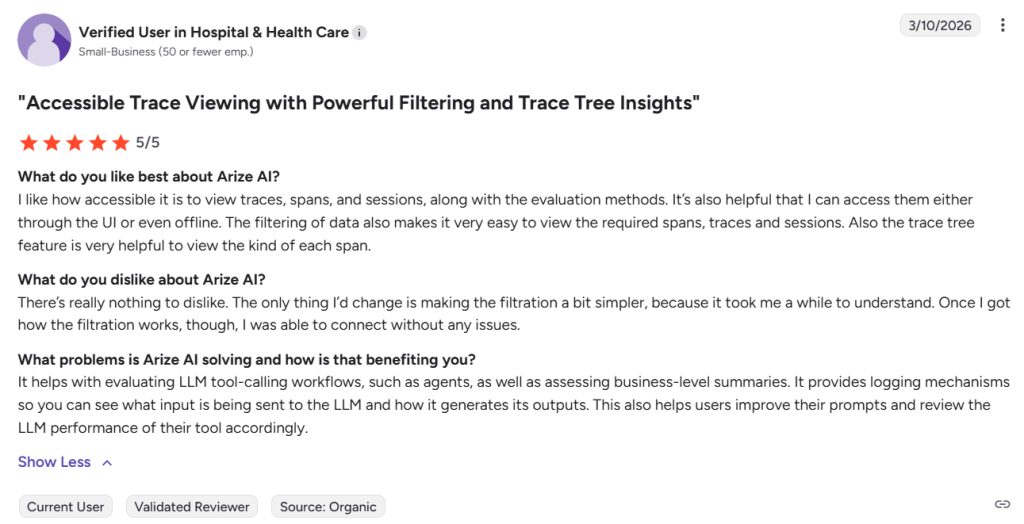
Arize AI reviews show positive but limited public review coverage, with G2 listing 4.2 out of 5 from 28 reviews at the time reviewed. G2 review themes mention tracing, experimentation, evaluators, annotations, model monitoring, customer support, field level observability, and development to production workflows.
Buyers should treat the rating as useful directional evidence because the public review volume is limited for a technical AI observability platform.
Alternatives of Arize AI
Arize AI alternatives include LLM observability platforms, AI evaluation tools, prompt management systems, model monitoring platforms, and full stack observability tools for teams comparing tracing, evals, drift detection, and production monitoring.
- LangSmith, best for teams building, debugging, evaluating, and deploying AI agents and LLM applications.
Choose it when agent engineering, LangChain ecosystem fit, tracing, prompt testing, and deployment workflows matter more than Arize AI’s broader ML and computer vision observability coverage. - Langfuse, best for teams that want an open source LLM engineering platform with tracing, prompt management, evaluations, metrics, and analytics dashboards.
Choose it when open source deployment, self hosting, LLM specific observability, and prompt versioning matter more than enterprise AI observability across traditional ML and LLM systems. - W&B Weave, best for teams using Weights & Biases that need LLM observability, tracing, evaluations, debugging, and iterative AI application improvement.
Choose it when generative AI evaluation and W&B workflow continuity matter more than adopting Arize AX as a separate observability platform. - Braintrust, best for teams that need production traces, evals, prompt and model comparison, and release quality workflows for AI products.
Choose it when evaluation driven AI release workflows matter more than Arize AI’s combined monitoring, dashboards, drift detection, and ML observability coverage. - Datadog LLM Observability, best for engineering teams already using Datadog that need to monitor, troubleshoot, evaluate, and secure LLM powered applications.
Choose it when full stack infrastructure observability, security signals, latency tracking, prompt injection detection, and LLM traces need to sit inside Datadog. - Evidently AI, best for AI teams that need open source based evaluation and observability for LLM applications, RAG systems, ML systems, and data pipelines.
Choose it when open source evaluation metrics, ML monitoring, LLM testing, and data quality checks matter more than Arize AI’s enterprise managed platform path. - Fiddler AI, best for enterprises that need LLM observability, model monitoring, risk detection, compliance workflows, drift tracking, performance monitoring, and explainability.
Choose it when AI governance, compliance, safety monitoring, model risk, and predictive ML explainability matter more than Arize AI’s Phoenix plus AX product structure.