
SHORT SUMMARY
- The Pomodoro Technique for studying uses 25-minute study sessions followed by 5-minute breaks, with a longer break after four sessions.
- Choosing one specific study task before starting the timer makes each session more effective.
- Study interval length should match the subject: shorter for math and practice, longer for reading, writing, and coding.
- Active recall during each session improves retention more than rereading notes.
- Common mistakes include vague tasks, skipped breaks, and using the same interval for every subject.
- Blitzit is a Pomodoro timer built for students, with a free trial and plans starting at $4.99 per month.
What Is the Pomodoro Technique for Studying?
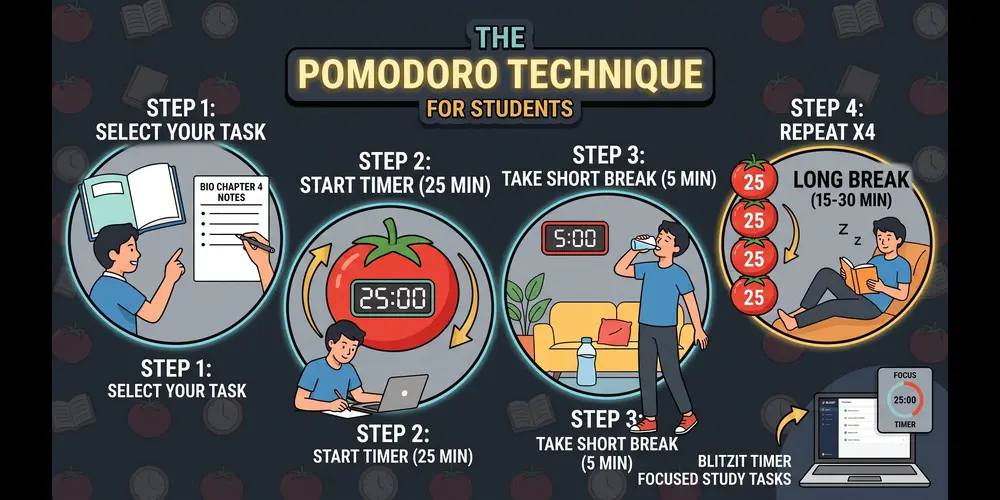
The Pomodoro Technique is a study method that breaks your study time into focused work sessions followed by short breaks. The traditional approach uses 25 minutes of study and 5 minutes of rest, repeated four times before a longer 15 to 30 minute break.
For students, the main benefit is structure. Instead of trying to study for several hours at once, you focus on one clear task for a limited period, take a break, and then start the next session. This makes it easier to manage large study tasks without constantly switching between subjects or distractions.
How the Pomodoro Technique Works
A basic Pomodoro study cycle looks like this:
- Choose one specific study task.
- Study for 25 minutes.
- Take a 5 minute break.
- Start another study session.
- Repeat the cycle four times.
- Take a longer 15 to 30 minute break.
The timer creates a clear boundary around each study session. During the work period, your attention stays on one task instead of moving between notes, messages, websites, and other subjects.
Why Pomodoro Works for Studying
Pomodoro makes a large study goal easier to break into smaller tasks. Instead of deciding to “study biology” for several hours, you can use one session to review a specific chapter, complete 10 practice questions, or revise a set of notes.
The regular breaks also prevent the study session from becoming one long stretch of screen time. The goal is not to complete as many timers as possible. It is to use each session for focused learning and give yourself enough time to recover between sessions.
Where Did the Pomodoro Technique Come From?
Francesco Cirillo developed the Pomodoro Technique while studying in Italy in the late 1980s. He used a tomato shaped kitchen timer to measure his work sessions, which led to the name “Pomodoro,” the Italian word for tomato.
Steps to Use the Pomodoro Technique for Studying
Using Pomodoro for studying is simple: choose one task, focus on it for 25 minutes, take a short break, and repeat. The key is to decide what you will accomplish before starting each session.
Choose One Specific Study Task
Start with one clear task instead of a broad goal like “study chemistry.” For example, you could review one chapter, solve 10 practice questions, or learn 20 vocabulary words.A specific task makes it easier to start and gives you a clear result to work toward during the session.
Set a Timer for 25 Minutes
Set your timer for 25 minutes and start working on the task. During this time, stay focused on that task and avoid checking your phone, email, or unrelated websites.
If you finish early, use the remaining time to check your answers, review your notes, or test yourself on what you learned.
Study Without Switching Tasks
Keep your attention on the task until the timer ends. If another task comes to mind, write it down and return to your current work instead of switching immediately.
This keeps the 25-minute session focused and prevents small distractions from turning into longer interruptions.
Take a 5 Minute Break
When the timer ends, stop studying and take a 5-minute break. Stand up, stretch, drink some water, or step away from your desk.
Try not to start an activity that is difficult to stop, such as scrolling through social media, because it can make it harder to return to studying.
Repeat the Cycle
Start another 25-minute study session after your break. Continue this pattern until you complete four Pomodoros.
Each session can focus on the same subject or a different task, depending on your study plan.
Take a Longer Break
After four Pomodoros, take a longer break of around 15 to 30 minutes. Use this time to step away from your study area and properly reset before starting another round.
Check What You Actually Learned
At the end of each session, take a moment to check your progress. Ask yourself what you can remember without looking at your notes and identify anything that still needs review.
How Long Should a Pomodoro Study Session Be?
The traditional Pomodoro session is 25 minutes of focused study followed by a 5-minute break. However, you do not have to use the same timing for every subject or study task. Longer sessions can work better when a task needs more uninterrupted focus.
25 Minutes of Study and 5 Minutes of Break
The 25/5 schedule is a good starting point for most students. It works well for tasks such as reviewing notes, learning vocabulary, answering practice questions, or studying a small section of a chapter.
If you are new to Pomodoro, start with 25 minutes and see how well you can maintain focus.
40 to 50 Minutes of Study and 10 Minutes of Break
Longer sessions can be useful for tasks that take more time to get into, such as essay writing, coding, reading difficult material, or solving complex problems.
A 40 to 50 minute study session followed by a 10 minute break gives you more uninterrupted time while still providing regular breaks.
When Should You Change the Pomodoro Length?
Change the session length when the standard 25 minutes does not fit the task. Use shorter sessions when you lose focus quickly and longer sessions when stopping after 25 minutes interrupts your concentration.
The goal is to find a study interval that helps you stay focused and make measurable progress, not to follow one timing rule perfectly.
What Pomodoro Interval Is Best for Different Subjects?
The best Pomodoro length depends on the type of work you are doing. A shorter session can work well for quick practice or memorization, while longer sessions may be better for tasks that need more uninterrupted concentration.
Math and Problem Solving
Use 25 to 40 minute sessions for math and problem solving. Set a clear target, such as completing 10 questions or working through one topic, rather than simply studying until the timer ends.
During the break, note any questions you could not solve so you can return to them in the next session.
Reading and Essay Writing
Reading and writing often benefit from 40 to 50 minute sessions, especially when you need time to understand a chapter or develop an argument.
For reading, focus on a specific section or number of pages. For essay writing, use each session for one stage, such as outlining, writing a section, or editing.
Coding and Technical Subjects
Longer sessions of 40 to 50 minutes can work well for coding and other technical subjects. Getting into the problem often takes time, so a longer session lets you understand the task and make progress before taking a break.
Use each session for one clear goal, such as completing a function, fixing a specific error, or studying one technical concept.
Language Learning
Shorter 20 to 30 minute sessions can work well for language learning. Use one session for vocabulary, another for grammar, and another for reading or listening practice.
Keeping each session focused on one skill makes it easier to see what you have practiced and what needs more work.
Exam Revision
For exam preparation, use each Pomodoro for active study rather than simply rereading notes. You can spend a session answering practice questions, testing yourself on key topics, reviewing mistakes, or explaining a concept without looking at your notes.
The right interval is the one that gives you enough time to make real progress without losing focus.
How to Make Each Pomodoro Study Session More Effective
A timer alone does not make a study session productive. You also need a clear goal, a distraction free setup, and a way to check what you actually learned.
Set a Clear Goal Before Starting
Decide what you want to finish before the timer starts. Instead of writing “study physics,” choose something measurable, such as completing 10 practice questions or reviewing one topic.
A clear goal helps you use the full session for useful work instead of deciding what to do after the timer starts.
Remove Distractions Before the Timer Starts
Put your phone away, close unrelated browser tabs, and keep only the materials you need for the task in front of you.
If you study at home, setting up a clear study space can also make it easier to stay focused. Our guide on how the Pomodoro Technique helps you beat procrastination covers more ways to make it easier to start and stay on task.
Use Active Recall Instead of Just Rereading
Use your study time to test yourself rather than reading the same notes repeatedly. Close your book and try to explain the topic, answer questions from memory, or write down the main points without looking.
This gives you a better idea of what you actually remember and what still needs review.
Keep a List of Interruptions
If you suddenly remember something you need to do, write it down instead of stopping your study session. You can check the list when the timer ends.
This simple habit lets you deal with other tasks without losing focus on your current subject.
Use a Timer That Keeps Your Task Visible
A timer is more useful when you can see both the countdown and the task you are working on. Blitzit combines tasks with a focus timer, so you can keep your study task visible while working through each session.
Try Blitzit for focused study sessions →
How to Create a Pomodoro Study Schedule
A Pomodoro study schedule works best when you plan your sessions around the subjects and tasks you actually need to complete. Instead of filling your day with timers, decide which subjects need the most attention and assign Pomodoros to them.
Start With Your Classes and Deadlines
Begin by listing upcoming exams, assignments, and other important deadlines. Give more study sessions to subjects that are difficult or have an earlier deadline.
This keeps your Pomodoro schedule connected to what you actually need to get done.
Assign Pomodoros to Each Subject
Break your study plan into specific sessions. For example, you might use two Pomodoros for math practice, two for biology revision, and one for English reading.
Give each session one clear task so you know exactly what to work on when the timer starts.
Mix Difficult and Easier Tasks
Avoid putting several difficult subjects back to back. After a demanding session, switch to something lighter, such as vocabulary review or reading.
This can make a longer study period easier to manage without losing focus.
Leave Time for Review
Keep some sessions available for reviewing mistakes, testing yourself, or going over topics you did not understand the first time.
A good study schedule should leave room for review rather than using every session to learn something new.
Example Pomodoro Study Schedule for One Week
| Day | Pomodoros | Main Focus |
| Monday | 4 | Math and biology |
| Tuesday | 4 | English and coding |
| Wednesday | 5 | Math practice and biology |
| Thursday | 4 | English and coding |
| Friday | 4 | Review difficult topics |
| Saturday | 5 | Practice tests and revision |
| Sunday | 2–3 | Light review and planning |
You can adjust the number of sessions based on your classes, workload, and available time. The important part is to plan what each Pomodoro is for, rather than simply trying to complete as many sessions as possible.
If you already use time blocking to organize your day, Pomodoro sessions can fit inside those larger blocks. Our guide on how to do time blocking explains how to plan your day around specific tasks and time periods.
What Are the Most Common Pomodoro Mistakes?
Pomodoro works best when you use it as a structure for focused studying, not as a goal to complete as many timers as possible. These common mistakes can make the technique less useful.
Choosing Tasks That Are Too Big
A task like “study chemistry” is too broad for one Pomodoro. Break it into something specific, such as reviewing one topic, solving 10 questions, or making notes from one section.
Checking Your Phone During a Session
Checking messages or social media during a study session breaks your focus and makes it harder to return to the task. Keep your phone away or put it on silent until the timer ends.
Using Breaks for More Screen Time
A five-minute break can quickly become much longer when you start scrolling through social media or watching videos. Use your break to stand up, stretch, drink water, or simply step away from your desk.
Stopping Because One Pomodoro Ends
The timer is there to structure your study time, not to force you to stop at an inconvenient moment. If you are finishing a problem or thought, complete it and then take your break.
Using the Same Interval for Every Subject
A 25-minute session may work well for vocabulary or practice questions but feel too short for coding, essay writing, or difficult reading. Adjust the interval when the task needs more uninterrupted time.
Focusing on Time Instead of Learning
Completing four Pomodoros does not automatically mean you had a productive study session. Focus on what you learned, what you completed, and what still needs review.
If your main problem is starting a task rather than managing study time, our guide on how the Pomodoro Technique helps you beat procrastination explains how shorter work sessions can make getting started easier.
Which Pomodoro Timer Is Best for Studying?
Any timer works for the Pomodoro Technique, including your phone or a basic kitchen timer. A dedicated app becomes useful once you want to track sessions, manage tasks alongside the timer, or build a longer-term study habit.
Blitzit
Blitzit keeps your study task and Pomodoro timer in the same place, so you are not switching between a separate to-do list and a separate countdown app during your session. Its floating focus timer stays visible on screen while you work, which makes it easier to stay on the task you planned instead of losing track of time.
Blitz Mode turns your planned study tasks directly into timed sessions, so you do not need to manually set a new timer before each Pomodoro. It also keeps a record of completed sessions, which is useful if you want to see how many Pomodoros a subject actually takes compared to what you expected.
Blitzit offers a 7-day free trial, with paid plans starting at $4.99 a month. You can check the current Blitzit discount if you want to try it for your study sessions.
Free Pomodoro Timer Options
If you just need a simple timer without task management built in, a few free options cover the basics well. Pomofocus runs in your browser, lets you adjust work and break lengths, and does not require an account to use. Marinara Timer works the same way, offering a plain countdown built around the standard 25/5 cycle for students who do not need any extra features.
These options work well if you already keep your task list somewhere else and just need something to run the timer.
For a closer look at more options, including apps built specifically around task tracking and longer study sessions, see our full Best Pomodoro Timer Apps guide.
FAQs About Pomodoro for Studying
Is the Pomodoro Technique Good for Studying?
The Pomodoro Technique is good for studying because it takes something vague, like “study for a few hours,” and turns it into something you can actually start in the next few minutes. Choosing one task, working for a set period, and taking a real break gives your study time a clear structure without requiring a complicated system to follow.
It is not a fix for every study problem on its own. How well it works still depends on picking specific tasks, using active recall instead of just rereading, and adjusting the interval when a subject needs more time. But as a starting point, it is one of the simplest ways to turn study time you keep putting off into study time you actually get through.