

SHORT SUMMARY
- Pomodoro can help with ADHD, but the standard 25 minute format does not work for everyone
- A visible timer supports task initiation, time awareness, and distraction control
- There is no large clinical trial proving Pomodoro treats ADHD directly, results come from smaller research and real world use
- Work sessions can range from 10 minutes for hard tasks to 60 minutes for deep focus, 25 minutes is only a starting point
- Hyperfocus, wrong interval length, and unstructured breaks are the most common reasons the standard version fails
- An interrupted session is not a failure, it just shows the interval or task needs adjusting
- Pomodoro works best alongside body doubling, task batching, or a clear task list, not as a stand alone fix
Yes, the Pomodoro Technique can help with ADHD, but the standard 25 minute format does not work for everyone. Short timed work sessions can make tasks easier to start, create a clear sense of time, and reduce long periods of unfocused work.
The key is to adjust the work interval, break length, and task size around your actual attention span rather than treating 25 minutes as a fixed rule.
What Is the Pomodoro Technique?
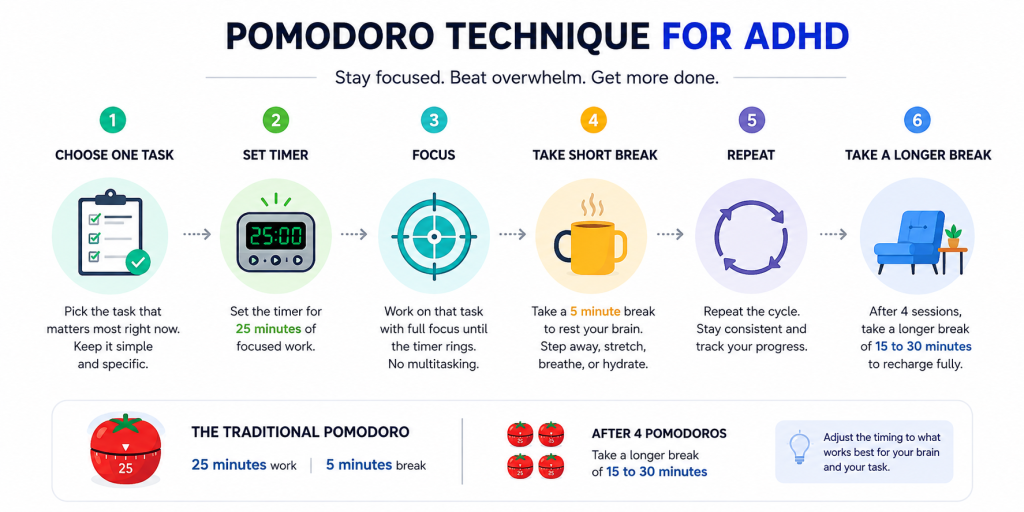
The Pomodoro Technique is a time management method that divides work into short timed sessions followed by breaks. The traditional method uses 25 minutes of focused work followed by a 5 minute break.
The basic process is:
- Choose one task.
- Set a timer for 25 minutes.
- Work only on that task.
- Take a 5 minute break.
- Repeat the process.
- Take a longer 15 to 30 minute break after four sessions.
The method makes large tasks feel more manageable by giving you a short and clearly defined period to work.
For a complete explanation of the traditional method, see our guide on how the Pomodoro Technique works.
Why Is the Pomodoro Technique Recommended for ADHD?
The Pomodoro Technique can help with ADHD because it gives structure to tasks that otherwise have no clear starting or stopping point.
A visible timer creates an external reminder of time. Short work sessions also reduce the mental effort required to start a large task.
The method can help with:
- Task initiation: A 15 or 25 minute session feels easier to start than an open ended work period.
- Time awareness: A timer provides a visible boundary for each work session.
- Distraction control: One defined task gives your attention a specific target.
- Break management: Planned breaks prevent long periods of continuous work.
- Progress tracking: Completed sessions provide a simple way to see how much work was done.
The method does not treat ADHD itself. It is a productivity strategy that can make certain tasks easier to manage.
Does the Pomodoro Technique Actually Work for ADHD?
The Pomodoro Technique can be useful for people with ADHD, but there is no large clinical trial showing that Pomodoro directly treats ADHD symptoms.
Its usefulness comes from several principles that are commonly used in productivity strategies for ADHD, including external time cues, smaller tasks, structured breaks, and reduced task switching.
Results also vary between people. A 25 minute session may be too long for someone who struggles to start a task, while it may interrupt someone who becomes deeply focused once work begins.
That is why the standard Pomodoro format works better as a starting point than a strict rule.
Why the Standard Pomodoro Method Can Fail for ADHD
The traditional 25 minute work and 5 minute break cycle is simple, but several parts can create problems for people with ADHD.
Hyperfocus Can Make the Timer Feel Like an Interruption
A timer can become frustrating when you are deeply focused on a task. Stopping immediately when the alarm rings may break your concentration instead of helping it.
25 Minutes Is Not the Right Length for Everyone
Some tasks require more than 25 minutes before you reach a productive flow. Other tasks become difficult to maintain after 10 or 15 minutes.
The original 25 minute interval was not designed specifically for ADHD.
Breaks Can Easily Become Distractions
A five minute phone break can quickly become 30 or 40 minutes. Apps, social media, and notifications make this especially easy.
A better break has a clear ending, such as stretching, getting water, or walking around the room.
An Interrupted Session Can Feel Like Failure
Missing a timer or getting distracted does not mean the method failed. It provides information about the session length, task difficulty, or environment that caused the interruption.
The goal is to create a system that works with your attention rather than forcing your attention to follow a fixed schedule.
Best Pomodoro Intervals for ADHD
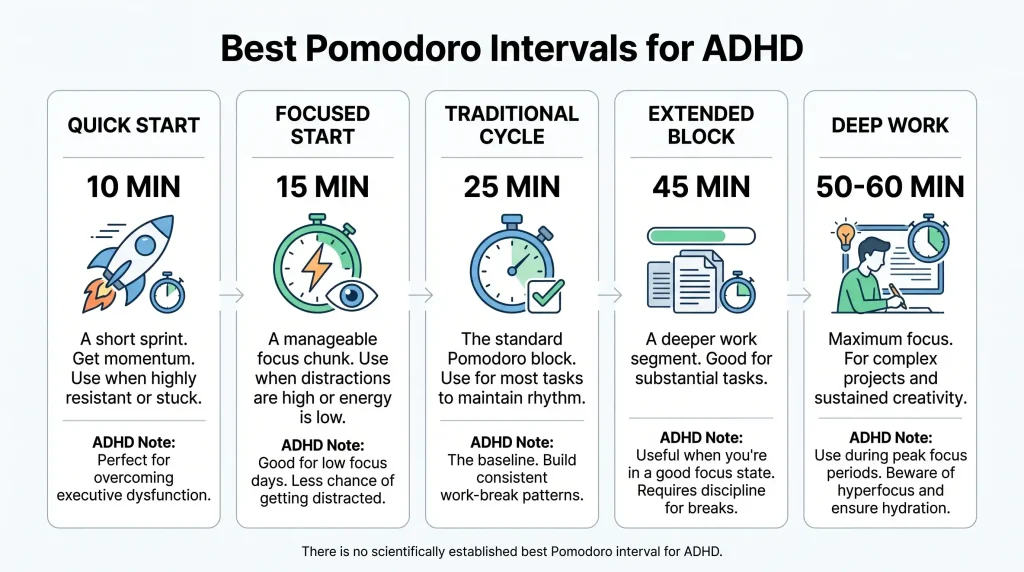
There is no scientifically established Pomodoro interval that works best specifically for ADHD. The traditional format uses 25 minutes, but the most useful interval depends on the person, task, and level of concentration.
| Work Time | Best For |
| 10 minutes | Very difficult tasks or getting started |
| 15 minutes | Low focus or high distraction |
| 25 minutes | Traditional Pomodoro sessions |
| 45 minutes | Longer tasks with stronger concentration |
| 50 to 60 minutes | Deep work where frequent stops become disruptive |
Start with a shorter interval when task initiation is the main problem. Longer sessions can work better when stopping frequently breaks your concentration.
How to Adjust Pomodoro for ADHD
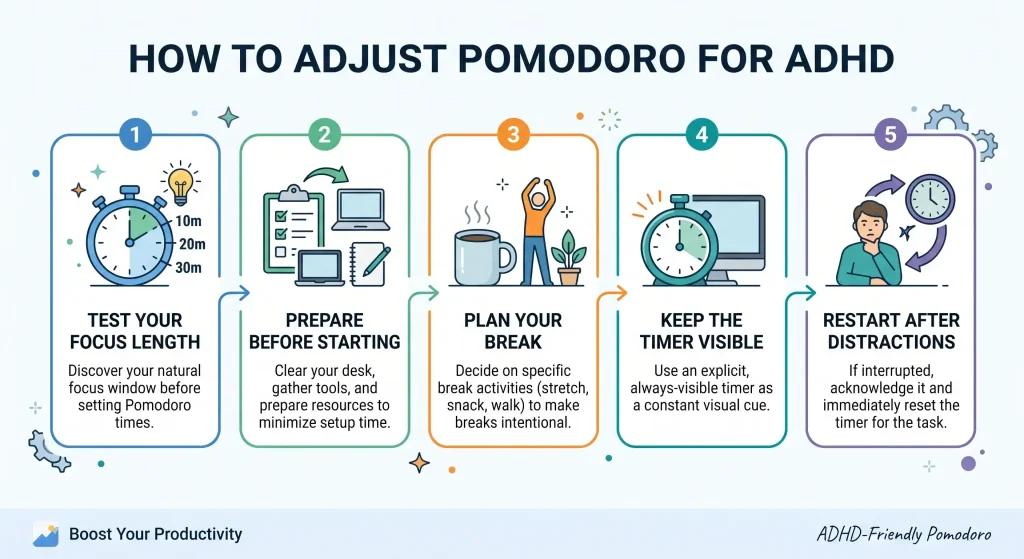
A few simple changes can make the method easier to follow.
Test your natural focus length. Try 15 minute sessions for several days, then test 25 or 45 minute sessions. Track when your attention starts dropping.
Prepare before starting the timer. Close unnecessary tabs, silence notifications, put your phone away, and write down the exact task.
Plan your break before it starts. Choose an activity with a clear endpoint instead of opening an unlimited source of distraction.
Keep the timer visible. A visual countdown provides a constant reminder of how much time remains.
Allow interrupted sessions. Restarting after a distraction is part of the process. One interrupted session does not invalidate the work already completed.
For more practical ways to use Pomodoro for focused work, see our guide on how the Pomodoro Technique keeps you focused.
Pomodoro for ADHD and Procrastination
Pomodoro can also help reduce procrastination by making the starting point smaller.
Instead of telling yourself to finish an entire report, set a timer and commit to working on the report for 15 minutes. The smaller commitment removes some of the pressure around starting.
The same approach can work for studying, writing, emails, household tasks, and other activities that are easy to postpone.
For more strategies, see our guide on how the Pomodoro Technique helps you beat procrastination.
When Pomodoro Alone Is Not Enough
Pomodoro works best as one part of a broader productivity system.
Body doubling adds another person to the working environment and can provide accountability that a timer cannot provide.
Task batching helps when constant task switching is the main problem. Emails, calls, and similar administrative tasks can be grouped into one work period.
A clear task list also matters. A timer cannot decide what deserves attention first, so defining the next action before starting reduces decision fatigue.
People who use ADHD medication can also notice different focus patterns throughout the day. Productivity routines can be adjusted around personal schedules and professional medical guidance.
How to Choose a Pomodoro Tool for ADHD
A good Pomodoro app should make starting and continuing a session easier rather than adding more setup.
Look for:
- Custom work and break durations
- A visible countdown timer
- Simple session controls
- Notifications that are easy to notice
- Task or session tracking
- Optional focus features
- Minimal setup requirements
Blitzit is one option for people who want Pomodoro timing combined with task management. It brings tasks and timed focus sessions into the same workflow, which can reduce the need to switch between separate productivity tools.
You can try Blitzit to see whether its workflow fits your routine.
Readers comparing Pomodoro apps can also check our Blitzit review and discount guide for its features, pricing, and available offer.
The best tool is the one that removes friction from starting a session. A complicated timer with too many settings can create another reason to delay the task.
Pomodoro for Studying With ADHD
Pomodoro can work well for studying because it breaks long study periods into smaller sessions.
A simple study session can look like this:
- Choose one chapter, topic, or assignment.
- Set a 15 or 25 minute timer.
- Study only that material.
- Take a short break.
- Repeat the cycle.
- Review what you completed before starting the next task.
Students can also use different intervals for different activities. Reading may work well with 25 minutes, while difficult problem solving may require a longer session.
Our guide on how to use the Pomodoro Technique for studying covers this workflow in more detail.
Mistakes to Avoid
Avoid these common mistakes when using Pomodoro for ADHD:
- Using 25 minutes simply because it is the traditional setting
- Making every work session the same length
- Using your phone during an unstructured break
- Starting the timer without defining the task
- Treating an interrupted session as failure
- Using too many productivity apps at once
- Expecting Pomodoro to solve every focus problem
The goal is consistency, not perfect sessions.
Final Verdict
The Pomodoro Technique is worth trying for ADHD, but the traditional 25 minute format should not be treated as a fixed rule.
Shorter sessions can make difficult tasks easier to start, while longer sessions can work better during periods of strong concentration. Planned breaks, clear tasks, and a simple timer make the method easier to maintain.
The most effective Pomodoro setup is the one that matches your attention span and reduces the effort required to start working.