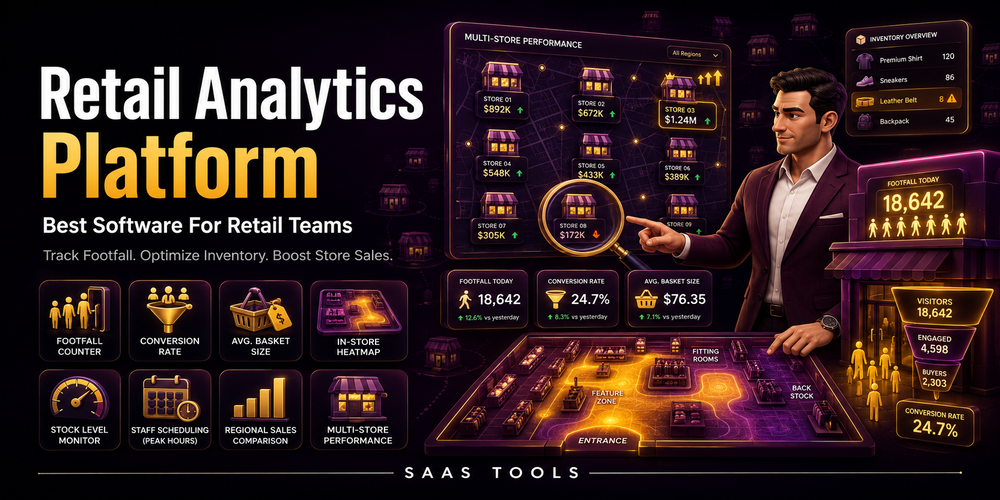
A retail analytics platform helps retail teams understand store sales, product performance, inventory movement, customer behaviour, staff activity, and location performance.
Retail teams do not only need sales totals. They need to know which products sell in store, which locations perform better, where inventory is moving, which staff members are involved in sales, and how customer behaviour changes across channels.
This guide compares retail analytics tools for store owners, retail operators, ecommerce and in store teams, and multi location retailers. For online store reporting, read our guide to ecommerce analytics tools. For retail staffing and HR data, see workforce analytics software.
What Is A Retail Analytics Platform?
A retail analytics platform collects and organises retail data so teams can understand store performance, product activity, customer behaviour, and operational trends.
A basic sales report shows what was sold. A retail analytics dashboard goes deeper by connecting sales, products, inventory, locations, staff, orders, and customer activity.
Useful retail analytics can include:
- Store sales reporting.
- Product and SKU performance.
- Inventory movement.
- Staff sales reporting.
- Location performance.
- Customer purchase behaviour.
- Online and in store sales visibility.
- Forecasting or planning insights.
Best Retail Analytics Platforms Comparison
The best retail analytics platform depends on whether your team needs POS reporting, inventory visibility, multi location analytics, foot traffic data, or retail planning insights.
| Tool | Best fit | Useful for |
|---|---|---|
| Shopify POS Analytics | Shopify retail reporting | POS sales, products, variants, vendors, product types, locations, and staff sales reports |
| Lightspeed Retail | Retail POS and inventory analytics | Sales reporting, inventory visibility, product performance, customer data, and multi location retail operations |
| Square for Retail | Simple retail reporting | POS reporting, item performance, inventory, customer data, and retail sales visibility |
| RetailNext | In store traffic analytics | Foot traffic, shopper behaviour, conversion, store performance, and physical retail insights |
| Trax Retail | Shelf and store execution analytics | Shelf availability, store images, product visibility, retail execution, and merchandising insights |
| Oracle Retail Analytics | Enterprise retail analytics | Retail planning, forecasting, inventory, merchandising, performance analysis, and enterprise retail data |
Shopify POS Analytics
Shopify POS Analytics is a good fit for Shopify merchants that sell in person and want retail sales reports inside Shopify.
Shopify retail sales reports help merchants review point of sale orders by product, SKU, or staff. Shopify’s retail sales reports include only sales made at a POS location.
Shopify reports can show POS total sales by product, product variant, vendor, product type, POS location, staff member, staff daily sales total, and staff sales total.
Best for: Shopify stores that need native retail sales reporting for in person sales, staff activity, products, and POS locations.
Lightspeed Retail
Lightspeed Retail is a good fit for retailers that want POS reporting, inventory visibility, product data, and multi location retail operations.
Lightspeed is commonly used as a retail POS and commerce platform. For retail analytics, the main fit is operational reporting around sales, inventory, products, customers, and store activity.
Retail teams can use this type of platform to connect checkout data with product and inventory decisions. It is especially useful when a store needs POS, inventory, customer records, and reporting in one retail workflow.
Best for: retailers that need POS connected with inventory, product performance, customer data, and multi location visibility.
Square For Retail
Square for Retail is a good fit for small retailers that want simple POS reporting, item tracking, inventory visibility, and sales data.
Square is commonly used by physical and online sellers for payments and POS workflows. For retail teams, the analytics value is in connecting point of sale activity with item data, customers, inventory, and sales reporting.
Square for Retail can be a practical fit when a store wants a simpler retail system rather than an enterprise retail analytics stack.
Best for: small retailers that need straightforward POS reporting, item level visibility, inventory tracking, and sales performance views.
RetailNext
RetailNext is a good fit for physical retail teams that need in store traffic analytics and shopper behaviour insights.
RetailNext is focused on physical store analytics. This makes it different from POS only tools because it is more relevant when teams need to understand store traffic, shopper movement, conversion, and in store performance.
Retail analytics of this type can help teams compare store traffic with sales outcomes and understand how physical store behaviour affects performance.
Best for: retail teams that need foot traffic analytics, shopper behaviour data, conversion insights, and store level performance analysis.
Trax Retail
Trax Retail is a good fit for retail and CPG teams that need shelf visibility, store execution analytics, and merchandising insights.
Trax uses store image and retail execution data to help teams understand what is happening on shelves. This type of retail analytics is useful when teams care about product availability, shelf execution, merchandising, and store compliance.
It is different from a POS analytics tool because the main focus is not only transactions. It is more about shelf conditions, product presence, and retail execution.
Best for: retail and CPG teams that need shelf analytics, store execution insights, product visibility, and merchandising data.
Oracle Retail Analytics
Oracle Retail Analytics is a good fit for enterprise retail teams that need analytics connected with planning, forecasting, merchandising, inventory, and retail operations.
Oracle’s retail software ecosystem is more enterprise focused than a small business POS tool. It is relevant when a retailer needs analytics across retail planning, inventory, merchandising, forecasting, and operational performance.
This type of retail analytics platform is usually better suited to larger retailers with complex data, multiple departments, and enterprise retail systems.
Best for: larger retail teams that need enterprise retail analytics across planning, forecasting, merchandising, inventory, and performance data.
Which Retail Analytics Platform Should You Choose?
Choose the retail analytics platform that matches your store model, data sources, and main retail decision problem.
| If your main problem is | Shortlist first |
|---|---|
| Shopify POS sales and staff reporting | Shopify POS Analytics |
| POS, inventory, customer data, and multi location operations | Lightspeed Retail |
| Simple retail POS reporting and item visibility | Square for Retail |
| Foot traffic and in store shopper behaviour | RetailNext |
| Shelf availability and store execution | Trax Retail |
| Enterprise retail planning and analytics | Oracle Retail Analytics |
A small retailer may start with Shopify POS Analytics or Square for Retail. A growing multi location retailer may compare Lightspeed Retail and RetailNext. A retailer with shelf execution or merchandising problems may shortlist Trax Retail. An enterprise retailer may need Oracle Retail Analytics for broader planning and operations.
FAQ’s
Editorial Note
This article is written with care, but some details may change or contain unintentional mistakes. If you find anything outdated or incorrect, please contact us so we can review and correct it.