
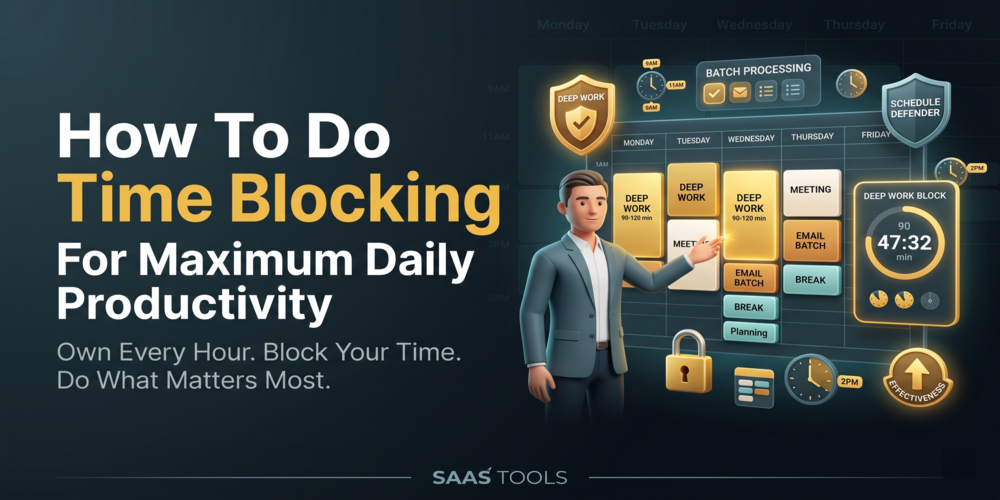
Time blocking helps you allocate specific periods of your day to important tasks instead of reacting to interruptions and distractions. When combined with the Pomodoro Technique, time blocking becomes easier to follow because each block has a defined focus period and break structure.
What Is Time Blocking?
Time blocking is a productivity method that assigns specific tasks to specific periods on your calendar.
Instead of working from a simple to do list, you reserve dedicated time for individual activities.
A typical schedule may include:
- Email management from 9:00 to 9:30.
- Project work from 9:30 to 11:00.
- Meetings from 11:00 to 12:00.
- Administrative tasks from 14:00 to 15:00.
This approach creates structure and reduces decision fatigue throughout the day.
How Does Time Blocking Work?
Time blocking works by assigning work to predefined time slots before the day begins.
The process follows four steps:
- List your most important tasks.
- Estimate how much time each task needs.
- Assign tasks to calendar blocks.
- Follow the schedule during the day.
Rather than deciding what to do next after every task, the schedule provides a clear sequence of work.
How To Use Time Blocking With A Pomodoro Timer
The simplest method is to divide each time block into Pomodoro focus sessions.
For example:
| Time Block | Activity | Pomodoro Sessions |
|---|---|---|
| 09:00 to 10:00 | Content writing | 2 sessions |
| 10:00 to 10:30 | Email management | 1 session |
| 11:00 to 12:30 | Project work | 3 sessions |
| 14:00 to 15:00 | Research | 2 sessions |
This combines long term planning with short term focus management.
Step By Step Time Blocking Process
A structured process makes time blocking easier to maintain.
1. Identify Priority Tasks
Select the most important work before scheduling anything else.
Focus on tasks that contribute directly to your goals.
2. Create Dedicated Time Blocks
Reserve calendar space for each task.
Avoid assigning multiple unrelated activities to the same block.
3. Add Pomodoro Sessions
Break each block into focused work intervals.
A 60 minute block can contain two 25 minute focus sessions and a short break.
4. Review Progress Daily
Evaluate completed and incomplete blocks at the end of the day.
This helps improve future planning accuracy.
Is Time Blocking Effective?
Time blocking is effective because it creates clear boundaries around work.
Potential benefits include:
- Better prioritisation.
- Reduced context switching.
- Improved focus.
- More predictable schedules.
- Greater visibility into workload.
The method is particularly useful for knowledge workers, students, and remote teams.
Does Time Blocking Work For Productivity?
Time blocking works best when schedules remain realistic and flexible.
Overloading a calendar often leads to missed blocks and frustration.
A practical schedule includes:
- Focus blocks.
- Meeting blocks.
- Administrative blocks.
- Buffer time between major activities.
This creates a system that can adapt to unexpected changes.
Using A Pomodoro Timer For Time Blocking
A dedicated timer can simplify time blocking by managing focus intervals automatically.
Instead of manually tracking work and break periods, productivity tools can support a more consistent workflow.
Blitzit is one example of a desktop productivity tool designed around focused work sessions and task management.
Learn more here:
https://saastools.blog/pomodoro-timer-apps/blitzit-discount-coupon/
Related Productivity Guides
These guides cover planning, focus management, and Pomodoro workflows.
- How To Plan Your Day With A Daily Planning App.
- How To Plan Your Day At Work With A Pomodoro Timer.
- How To Do Pomodoro Technique With A Desktop Timer.
- How Does The Pomodoro Technique Work For Better Focus.
These articles cover complementary productivity topics without overlapping with time blocking methodology.
Conclusion
Time blocking works by assigning specific tasks to specific periods of the day, while Pomodoro timers help maintain focus within those blocks.
Combining both methods creates a structured workflow that supports planning, concentration, and consistent progress.
FAQ’s
Editorial Disclaimer
This article is written with care, but some details may change or contain unintentional mistakes. If you find anything outdated or incorrect, please contact us so we can review and correct it.