

What Is Kodezi?
Kodezi is an AI-powered coding assistant and autonomous codebase platform that helps developers find bugs, apply fixes, generate documentation, and keep their codebase healthy without manual intervention. It positions itself as an AI CTO for codebases, going beyond autocomplete to actively maintain and evolve your code as you build.
Who It Is For
Individual developers, professional engineers, and development teams who want autonomous bug fixing, code documentation, and codebase maintenance without adding manual overhead.
Best Use Case
Autonomous bug detection and fixing, automated PR reviews, and codebase documentation for teams that want AI working on code maintenance while developers focus on building.
Standout Value
Kodezi OS actively heals bugs, patches vulnerabilities, and updates documentation without being asked, making it one of the few tools that operates as a true autonomous coding layer rather than a reactive assistant.
Setup Time and Support
Free plan requires no credit card and works directly in the browser via Web IDE. CLI setup is available for deeper codebase integration. Support available via documentation, Discord community, and dedicated channels on paid plans.
Why Kodezi Stands Out
Unlike traditional AI coding assistants that wait for instructions, Kodezi proactively scans your codebase, detects issues, and applies intelligent fixes automatically. It explains why bugs occur and how to prevent them, making it valuable for both productivity and learning.
Kodezi Key Features
- Autonomous Bug Fixing: Detects and fixes bugs automatically across your codebase without waiting for manual instructions, keeping code clean as you build
- Kodezi OS: An autonomous operating system layer for codebases that heals vulnerabilities, evolves code, and maintains software health proactively
- Kodezi CLI: Command line tool that scans local repositories, suggests pull-ready fixes, and catches issues before they reach CI or production
- Automated Code Reviews: Reviews and documents pull requests automatically across version control platforms, summarizing changes and flagging security risks
- Code Documentation Generation: Automatically generates and updates inline comments and documentation so your codebase stays readable and maintainable
- AI Code Optimizer: Eliminates bloat, reduces unnecessary lines, and refactors code for better performance and maintainability
- KodeziChat: Codebase-aware chat that lets you ask questions, generate code, and search your project using natural language
- Language and Framework Conversion: Swap code from one language or framework to another instantly without losing context or functionality
- Kodezi Create: Generate production-ready code from plain English prompts directly in the Web IDE with no setup required
- Security Vulnerability Detection: Automatically uncovers security risks and patches vulnerabilities before code reaches production
- Big O Analysis: Analyzes code complexity across multiple languages and generates detailed performance results to identify algorithm bottlenecks
- API Testing with Swagger: Generates OpenAPI 3.0 specifications from backend routes and hosts a shareable Swagger frontend for testing production APIs
Pros and Cons of Kodezi
Pros
- Autonomous Codebase Maintenance: Kodezi OS proactively heals bugs, patches vulnerabilities, and updates documentation without being prompted, a capability most competitors do not offer
- Free Plan With Daily Credits: Free tier refreshes 25 credits daily with no credit card required, giving developers consistent free access rather than a one-time trial
- Explains Why Bugs Occur: Goes beyond fixing errors by telling developers what went wrong and how to prevent it, making it useful for learning and skill development
- Zero Setup Web IDE: Browser-based coding environment works instantly without installing anything, lowering the barrier to entry for new users
- Strong PR Automation: Automatically reviews, comments, and documents pull requests reducing the manual workload on engineering teams significantly
- Broad Language Support: Covers JavaScript, TypeScript, Python, Java, C++, Ruby, Go, and more making it practical for diverse development teams
- API Documentation Generation: Auto-generates OpenAPI 3.0 specs from backend routes saving significant time on API documentation and testing workflows
Cons
- Smaller Community Than Major Competitors: Less community presence compared to GitHub Copilot or Cursor which can make troubleshooting and peer support harder to find
- Advanced Features Locked Behind Higher Tiers: Kodezi OS and full CLI toolset require the $59.99 per month plan, making autonomous features inaccessible on lower tiers
- Less Suited for Pure Autocomplete Workflows: Developers looking primarily for fast inline code completion may find Kodezi less optimized for that use case compared to Cursor or Windsurf
- Early Stage Product Maturity: As a growing startup, long-term roadmap commitments and enterprise-grade SLAs are still maturing compared to established players
Kodezi Pricing Plans
Kodezi pricing information can change. Always verify current rates and any available Kodezi coupon or Kodezi discount directly on kodezi.com before purchasing.
|
Plan |
Price |
Included Features |
|
Kodezi Code |
$0 (Free forever) |
• Web-based IDE Access • Kodezi Create Access (Limited) • Basic ML Models • 25 credits/day (Monthly plan) / 50 credits/month (Annual plan) |
|
Kodezi Pro |
$9.99 / month (or $8.99 / month billed at $100 / year) |
• Kodezi Create + Web IDE Pro (Standard access) • Advanced Code Models • 100~/day credits (Monthly plan) / 250 credits/month (Annual plan) |
|
Kodezi CLI + OS |
$59.99 / month, per user (or $49.99 / month per user billed at $600 / year) |
• Full CLI Toolset + Kodezi OS Access • Chronos-1~ ML Models • Unlimited~ Credits • Unlimited~ Kodezi Create Access • Smart PRs & Auto-Healing (Self-Healing & Auto-Evolution) • Living Docs & Smart PR Engine • Dev Stack & Team Collaboration Integrations • Kodezi OS Intelligence (Memory API & Cortex Dashboard) • Live Support |
Kodezi Top Integrations
- GitHub: Automates pull request reviews, generates commit-level fixes, and catches bugs before they merge into the main branch
- GitLab: Connects to GitLab repositories for automated code reviews, documentation updates, and issue detection within existing pipelines
- Bitbucket: Integrates with Bitbucket for automated PR reviews and codebase health checks without disrupting your version control flow
- Azure DevOps: Plugs into Azure DevOps pipelines to scan, fix, and document code automatically before it reaches production
- Visual Studio Code: Full Kodezi assistant available via VS Code extension for inline bug fixes, optimization, and documentation generation
- Kodezi Web IDE: Browser-based coding environment requiring zero setup, accessible directly from any device without installing a local editor
- Kodezi CLI: Terminal integration for developers who want autonomous codebase scanning, fixing, and OpenAPI generation from the command line
- JavaScript and TypeScript Projects: Native CLI support for JS and TS stacks covering debugging, optimization, and documentation across frontend and backend
- Python Projects: Full CLI and Web IDE support for Python developers covering bug detection, refactoring, and code generation
- Java Projects: Native support for Java codebases via Kodezi CLI for teams working on enterprise and backend applications
Kodezi Reviews
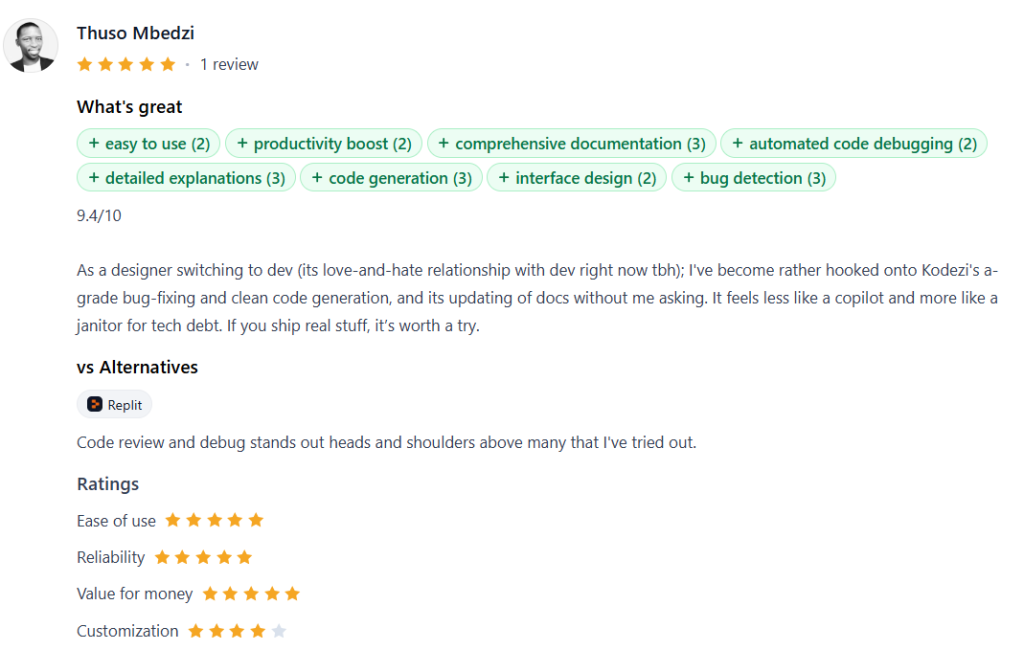
Developers across skill levels have shared feedback on Kodezi’s real-world performance. The consensus centers on its autonomous bug fixing, PR documentation quality, and strong value for small teams that want AI handling maintenance work.What Users Say About Kodezi
Alternatives of Kodezi
-
-
GitHub Copilot Best for developers who want AI assistance inside their existing editor without switching tools. Choose it when deep GitHub workflow integration and broad enterprise recognition are the priority.
-
Cursor Best for developers who want a fully AI-native editor with multi-file editing and agent mode. Choose it when codebase-aware chat and multi-step task execution matter more than autonomous maintenance.
- Windsurf (formerly Codeium) Best for developers who want a full agentic IDE with automatic codebase indexing at a competitive price. Choose it when you want Cascade-powered task execution inside a standalone editor.
- CodeMate Best for developers who want on-device privacy combined with automated PR reviews and codebase chat. Choose it when code security and automated code review are the top priorities.
- Tabnine Best for teams with strict data privacy and compliance requirements. Choose it when offline or fully private AI deployment is non-negotiable.
- Sourcegraph Cody Best for large engineering teams with complex multi-repo codebases. Choose it when enterprise-scale codebase search and AI assistance need to work together across very large repositories.
FAQ of Kodezi
Kodezi is an AI-powered coding assistant that acts as an “AI CTO” for your codebase. It goes beyond reactive assistance to proactively detect bugs, apply fixes, generate documentation, and maintain codebase health automatically.Yes. Kodezi offers a free plan (no credit card required) that includes 25 starter credits, plus 25 fresh credits every day. These can be used across the Web IDE, CLI, and Kodezi Create.Kodezi occasionally runs limited-time promotions. You should check kodezi.com directly for any active discount or coupon codes. Additionally, the premium CLI and OS plan offers a free 7-day trial with no credit card required.As of 2026, Kodezi Pro costs $9.99 per month, while the autonomous CLI and OS plan costs $59.99 per user per month. A free-forever tier is also available.Kodezi OS is an autonomous infrastructure layer (available only on the CLI and OS plan) that proactively heals bugs, patches vulnerabilities, and updates documentation in the background without needing manual instructions.It is a command-line tool that scans your local repositories, detects issues, suggests pull-ready fixes, and automatically generates assets like OpenAPI specs directly from your backend routes.Kodezi is designed to securely analyze your codebase without storing it or using it to train public AI models. You should verify the current privacy policy on kodezi.com for your specific plan’s exact data handling terms.Kodezi supports VS Code via an official extension and offers a zero-setup, browser-based Web IDE. The Kodezi CLI works across local environments, natively supporting languages like JavaScript, TypeScript, Python, and Java.Kodezi focuses heavily on autonomous, agentic maintenance—such as proactive bug fixing, documentation generation, and PR automation. GitHub Copilot focuses primarily on inline autocomplete and chat, though it benefits from broader enterprise adoption.Top alternatives include GitHub Copilot, Cursor, Windsurf, CodeMate, Tabnine, and Sourcegraph Cody. The best choice depends on whether you prioritize standard autocomplete, agentic codebase maintenance, or strict data privacy. -


